
Carl Jung: Memories, Dreams, Reflections
A third essay for paid subscribers on important cultural and philosophical figures.
See prior pieces on David Lynch and Julius Evola.
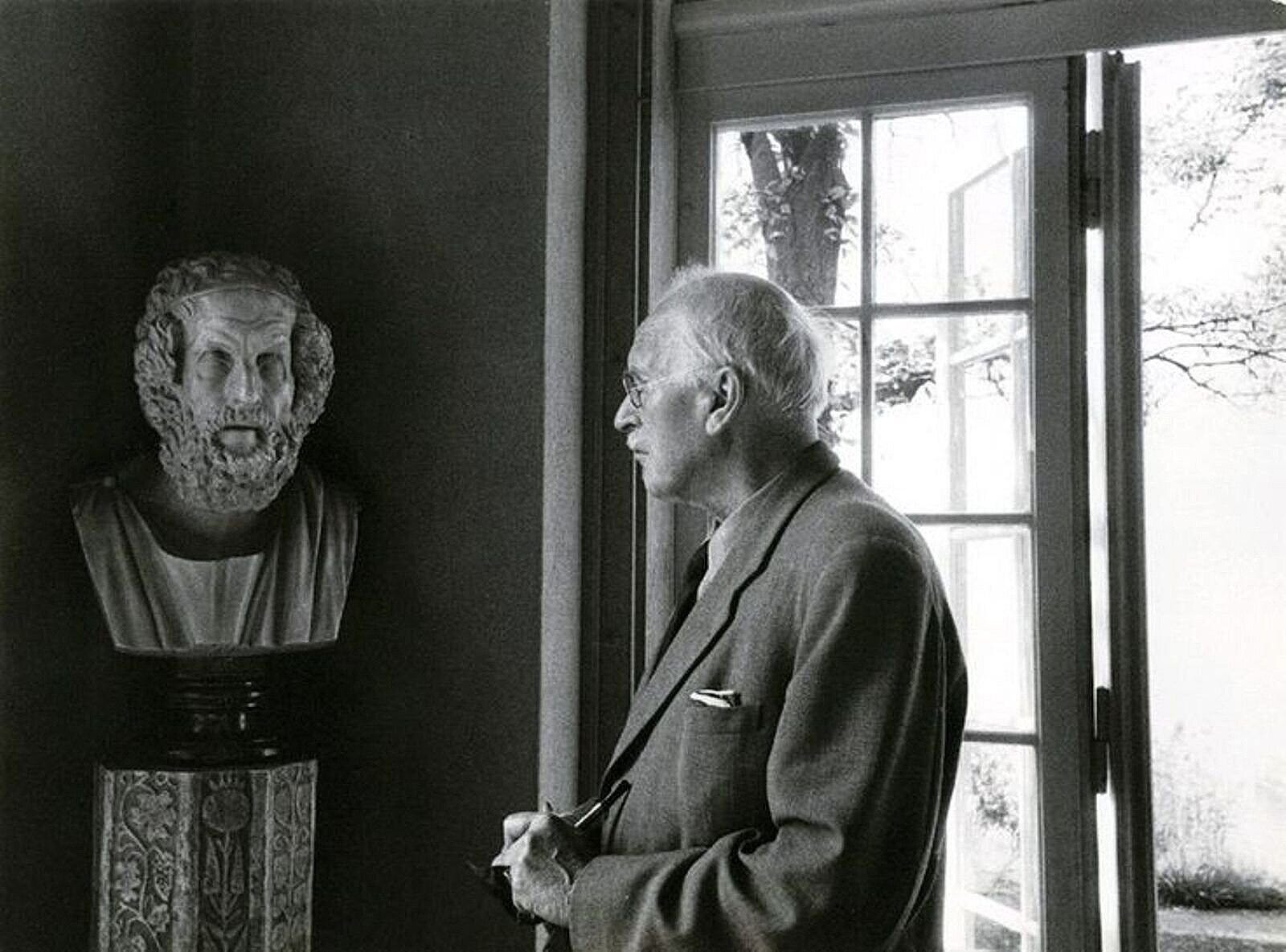
“To find their soul, the moderns must descend into the depths.”
Carl Jung, The Red Book
Despite some deep disagreements and errors, I can still safely conclude that the father of modern psychology, Carl Jung, was something of a genius for our times.
My disagreements include foundational religious concerns, whilst my affinity with the man (beyond our shared Swiss heritage and common travels to East Africa) concern a shared appreciation of Nietzsche and the importance of myth to a healthy-minded humanity.
Furthermore, his belief in a pysche that draws on deep historical and collective resources, has served as a bulwark against the denigration of humanity purveyed by Freud and his followers.
(These resources often being accessible via dreams, which represent a door into “the great cosmic night.”)
In fact, I would argue that much of what Jung actually wrote is largely suppressed in our era and its academic discourse. (This is true of Nietzsche too.) It is incendiary to learn precisely what such a learned and revered man of science and letters of the first half of the twentieth century truly believed about the modern world and the causes of its decadence.
And knowing this also goes a long way to understanding why, despite the mass availability of psychological counselling and treatment, incidence of mental illness continue to increase.
I also admire his medical humility, especially writing now post-2020.
In his autobiography, he wrote, “When important matters are at stake, it makes all the difference whether the doctor sees himself as a part of the drama, or cloaks himself in his authority.”
Like an even greater genius, Dostoevsky, Jung foresaw the ‘rivers of blood’ that would flow in the 20th century:
Towards the autumn of 1913, the pressure which I had felt was in me seemed to be moving outwards, as though there were something in the air. The atmosphere actually seemed to me darker than it had been. It was as though the sense of oppression no longer sprang exclusively from a psychic situation, but from concrete reality. This feeling grew more and more intense… That winter someone asked me what I thought were the political prospects of the world in the near future. I replied that I had no thoughts on the matter, but that I saw rivers of blood.
And thus the West would fall. Not only in blood, but also in the errors of his erstwhile friend and partner, Freud, along with various other modern dogmas.
Yet, in the midst of it, Jung would see some kind of hidden potential in all the chaos, precisely because the problems of psyche are always equally the problems of an entire world. And a problem is a journey.
