
Modern Africa: Time, Loyalty, Identity

The Polish journalist, Ryszard Kapuściński, travelled throughout Africa during the postcolonial period and recorded his insights in the renowned work, The Shadow of the Sun.
He was the Polish Communist regime’s accredited reporter in Africa, thus hardly a writer unsympathetic with the newly independent states who had found great support in the Eastern Bloc.
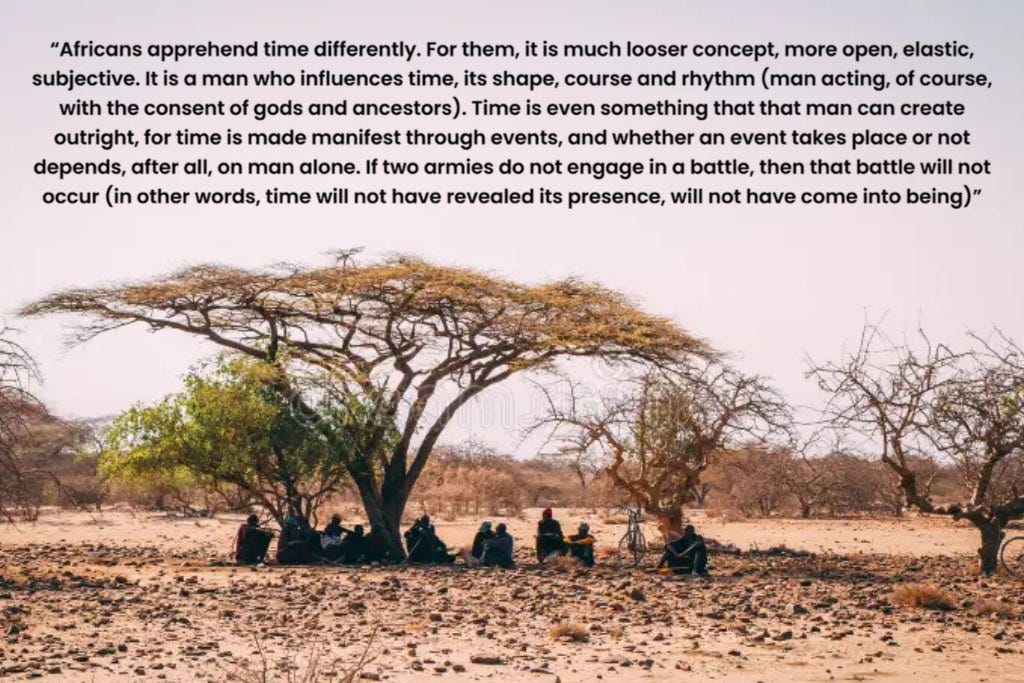
One passage that has remained with me comes from the beginning of the book and relates to how time is perceived differently in Africa (by this he largely means Sub-Saharan Bantu cultures).
An extract:
Time: Backwards and Forwards
I thought of this after a friend of mine, Roman Cabanac posted this interesting video on X:
As hinted at in the video, a sense of progress towards a great, oncoming future, was inculcated into the European mind by Christianity.
Africa, separated by vast deserts and oceans until the Age of Exploration, had a different conception of time. No doubt because of differing geography, religion, and race. Everything flowed backwards.
For Christendom, there had been a waiting for the coming of the saviour, a sense of waiting experienced mostly by the Jews (not exclusively) which had become retroactively the Mediterranean world’s story too. His first coming.
And now we wait for a great consummation, what Jesus called ‘the new world’ or the ‘regeneration,’ depending on how one translates the Greek word ‘palingenesia.’ Time flows forward in expectation.
This view of time was attenuated by the scientific and industrial revolutions, in which Newton’s vision of the universe presupposed a kind of universal clock, which relates to the notion of time as a commodity.
It is likely this recasting of time was also influenced by the rise of Protestantism and its new work ethic wherein the commercial, material world was no longer considered sacramental. (You could argue that this perspective would be modified again by the theory of relativity.)
Now, it is not hard to see the significance this has for modern African nation-states, which were a kind of European transplant into Africa. Hard borders, central banks, parliaments, industrial technics, mass literacy, suits and ties: these were transposed, not only by colonialists, but equally by the first leaders of independence who had imbibed a great deal of western progressivism and socialism in the education that had ironically been granted them by colonialism.
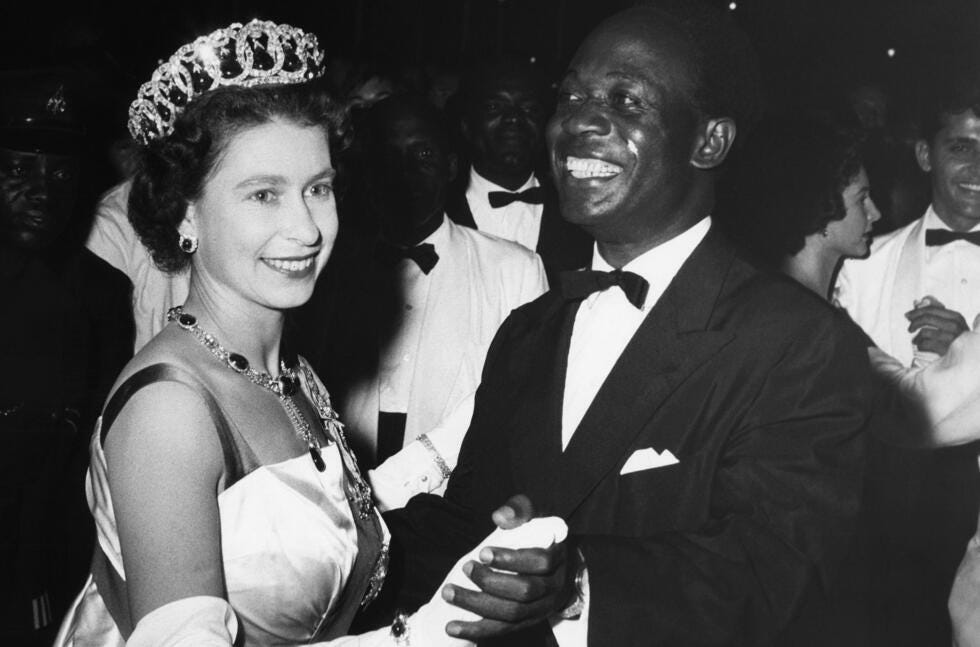
The assumption made at the time of independence, perhaps understandably so, was that western systems which had given rise to unprecedented power and wealth, and which were nascent in Africa colonies, could be ‘taken over’ by indigenous leaders and steered towards the advantage of indigenous peoples.
This comes with an obvious caveat: most independence leaders believed that these systems required a socialist overhaul in order to reach their full potential - a socialism still Eurocentric, as it was originated by the likes of Marx, Engels, and Lenin.
Figures like Kenyatta, Nkrumah, and Nyerere all studied in Britain, were highly influenced by left-wing British intellectuals who had imbibed socialism themselves, and turned it into ‘Fabianism’, and, they became, to differing extents, proponents of ‘African socialism.’
Postcolonialism: Time is out of joint
We all know what happened next in most of Africa.
Ghana under Nkrumah experienced one of the most rapid economic declines in history, to be matched later only by Zimbabwe. Tanzania under Nyerere experienced starvation. Uganda, Congo, Zambia, Mozambique, Rwanda, Nigeria and others all experienced massive declines in living standards, despite political ‘freedom.’
A few years ago, I read an account of a young Belgian couple who over-landed across Congo, very foolishly they later realised. They were concerned about how they would be received as ‘former colonizers’, but would be shocked when they realised that Belgian rule was remembered positively!
(Interestingly, Kenyatta would mostly ignore his earlier socialist ideas, largely because he believed they wrongly disdained the value of tribalism. In terms of policy, he embraced a basically free-market approach which would see decent economic growth, albeit marred by corruption and other issues, all of which would come to a head in serious electoral crises later on.)
But in general, much of postcolonialism, despite self-rule, would not see a great deal of real liberation or development, especially in comparison with postcolonial states in Asia and South America.
In fact, millions would die. Decolonization was a humanitarian disaster.
Even the revered anti-colonial writer, Chinua Achebe, of Things Fall Apart fame, would leave Nigeria and later deplore the lawlessness and danger of living in his homeland, which he had not known growing up under British rule. He would also have an Anglican burial, despite the anti-missionary posture of his famous novel.
Why was there so much human wreckage?
I have written before of Theodore Dalrymple and his belief that traditional communal loyalties (a form of which today is called ‘black tax’) subverted the state from inception. I will return to this below, especially because time and community are intertwined.
As for time, without a perception of its forward-flow, with a greater focus on one’s ancestors and the reservoir of a past more sacred than the future, the machinery of a modern state becomes very difficult to manage, to maintain, and to develop.
Instead, it is much easier to remember the struggle heroes of the past, and to continue to paint the former colonial authorities as some kind of darkly satanic force, who from the grave continue to hinder one’s efforts, thus robbing the present of any agency.
This is particularly obvious in South Africa. With every passing year since 1994, according to the ANC leadership, apartheid’s legacy seems to get more and more powerful. Unemployment has doubled since then, almost as though the past is more powerful than the present, or even the future. The ANC is, apparently, working hard for the masses, but the past is more destructive than any effort in the present.
This is not to say development has not happened at all, but when one looks at postcolonial states in other continents, it is starkly, tragically, true that Africa has fallen behind. This must be faced.
The idea of time flowing backwards is interesting. It has an appeal. But political correctness cannot inhibit us from concluding that time lived this way has caused devastation. It is right in front of our noses.
Wasted Time
Equally, it is not as though the European view of time today is without fault. Industrialisation and consumerism have come with massive sacrifices. Despite many benefits, it is clear our relationship with technology is unhealthy, as not only have we commodified time, but also human beings (think ‘human resources’), religion, and creation itself.
We have paid a price in culture and meaning. The sacred view of a future regeneration, when secularized, has become something darkly insidious, either a utopian vision which takes us backwards or forward to 1984, or a deep pessimism that all that can be gained today is pleasure and an absence of pain before the long eternal night begins.
The famous British journalist, Malcolm Muggeridge, has made the important point that when the West passed on so much its concepts and technics to its colonies, so much of the West had already been corrupted and ossified. Its technics were all it had.
In his memoir, Chronicles of Wasted Time, he remembers his time teaching in India as a young graduate, from the perspective of one who had later renounced his then Fabian/Socialist views:
… a people can be laid waste culturally as well as physically; not their lands but their inner life, as it were, sown with salt. This is what happened to India. An alien culture, itself exhausted, become trivial and shallow, was imposed upon them; when we went, we left behind railways, schools and universities, statues of Queen Victoria and other of our worthies, industries, an administration, a legal system; all that and much more, but set in a spiritual wasteland.
He also bemoans the likes of Nehru, the first leader of independent India, whose own ‘hollowness’ stemmed from his conversion first to crackpot European ‘theosophy’ and later to Fabianism while studying at Cambridge.
And what was lost was a cultural rootedness in the midst of oncoming political chaos and environmental degradation. Without that rootedness, how much can a people truly develop?
To be sure, like Muggeridge, I am not suggesting colonialism was this primal evil, this great and permanent stain on the conscience of the West. Colonialism is simply a tragic inevitability in the life-cycles of civilizations and warring states. Africa was of course colonised long before a European set foot on it, whether by Arabs or internally by the continent’s own tribal powers. This is most evident in the Bantu expansion from West Africa all the way to the Cape in South Africa, which has left little trace of those they conquered.
Recall too, 90% of African slaves who made their way over the Atlantic were already enslaved by their countrymen, many of whom fought to keep the slave trade alive when the British abolished it. The British would also go on to abolish the burning of widows in India and the Spanish human sacrifice in the Americas.
Colonialism was no Mongol invasion. A great deal of British colonialism stemmed from this desire to civilize, to heal, to convert. Livingstone pleaded for more British to come to Africa to bring medicine, law and order, to end slavery, and to build churches and schools.
Of course, the resources would be the overriding concern of cosmopolitan elites, as seen most notably in the quest for gold and diamonds in South Africa. But it is simplistic to say all of colonialism derived from greed.
As an example, my first Swiss forebear to arrive in South Africa did so to find work during the Great Depression, but also to lend his medical expertise in improving nutrition in the country for the poor. (Intriguingly, the National Party would help fund his efforts.)
Muggeridge seems to be correct. The trouble was not the railroads, the courts, etc. The trouble was the modern industrial state increasingly grown spiritually dead. And then transplanted. Societies who have grown up with it, developed it, still struggle today to humanize it. What of societies who received it, almost out of nowhere, just as the mother-civilization was blowing itself up in the 20th century?
The White Man’s Burden
Thus, what happened post-Word War II, after the great conquests of communism, was a kind of detonation of the so-called ‘white man’s burden’ - a term famously coined by Rudyard Kipling, but not, as is commonly thought, in reference to India, Africa, or any British colony.
Kipling wrote his poem, ‘The White Man’s Burden’, pleading with the US to colonize their new territory, the Phillipines, won after the Spanish War. Kipling believed it was the white man’s burden to spread their civilization across the known world, even if it came at great cost. (Kipling was no Christian, however. This civilization was limited to democracy, industrialisation, science, law and order, etc.)
Interestingly, the poem would be read in the US Senate, not to endorse its exhortation to the US, but to oppose it (which was done in vain.)
After reading the poem, Senator Tillman of South Carolina, said the following:
Those [Filipino] peoples are not suited to our institutions. They are not ready for liberty as we understand it. They do not want it. Why are we bent on forcing upon them a civilization not suited to them and which only means in their view degradation and a loss of self-respect, which is worse than the loss of life itself?
The US Senate has still not listened, to this day. As Pat Buchanan has often pleaded, equally in vain, and echoing the anti-colonial ideas of the English writer, GK Chesterton, the USA should be a nation and not an empire. A nation can relate healthily with other nations, and more healthily with itself. An empire, though perhaps historically inevitable in a tragic world, is a kind of loss.
Rejecting the Transplant
The degradation foreseen in the American Senate surely came to Africa. Ancient antibodies rejected this great transplant, and made the attempt almost monstrous. Time was stuck.
Theodore Dalrymple, doctor-psychiatrist-cultural critic, pointed out another inflammation of the immunity besides time: communal loyalties which rendered the state vulnerable to intense corruption.
He made this point in a seminal essay called After Empire, where he reflected on his experiences in Rhodesia, and the mixed legacy of colonialism as well as the disaster that would be the postcolonial era of Mugabe.
I will quote it at length because of its great depth of insight.
Dalrymple’s stint in Rhodesia was similar to Muggeridge’s in India:
I went to Rhodesia because I wanted to see the last true outpost of colonialism in Africa, the final gasp of the British Empire that had done so much to shape the modern world.
He describes life under the final government of the Rhodesian Front, which had, under the heroic RAF pilot, Ian Smith, unilaterally declared independence from Britain, making it a pariah state:
By the time I arrived, it had no friends, only enemies. Even South Africa, the regional colossus, with which Rhodesia shared a long border and which might have been expected to be sympathetic, was highly ambivalent toward it: for South Africa sought to ingratiate itself with other nations by being less than wholehearted in its economic cooperation with the government of Ian Smith.
I expected to find on my arrival, therefore, a country in crisis and decay. Instead, I found a country that was, to all appearances, thriving: its roads were well maintained, its transport system functioning, its towns and cities clean and manifesting a municipal pride long gone from England. There were no electricity cuts or shortages of basic food commodities. The large hospital in which I was to work, while stark and somewhat lacking in comforts, was extremely clean and ran with exemplary efficiency. The staff, mostly black except for its most senior members, had a vibrant esprit de corps, and the hospital, as I discovered, had a reputation for miles around for the best of medical care. The rural poor would make immense and touching efforts to reach it: they arrived covered in the dust of their long journeys. The African nationalist leader and foe of the government, Joshua Nkomo, was a patient there and trusted the care implicitly: for medical ethics transcended all political antagonisms.
He does recall, however, with some unease, the vast gulf between the life of space and beauty he lived, and the world of those who served in the white households.
The real luxuries were space and beauty—and the time to enjoy them. With three other junior doctors, I rented a large and elegant colonial house, old by the standards of a country settled by whites only 80 years previously, set in beautiful grounds tended by a garden “boy” called Moses (the “boy” in garden boy or houseboy implied no youth: once, in East Africa, I was served by a houseboy who was 94, who had lived in the same family for 70 years, and would have seen the suggestion of retirement as insulting). Surrounding the house was a red flagstone veranda, where breakfast was served on linen in the cool of the morning, the soft light of the sunrise spreading through the foliage of the flame and jacaranda trees; even the harsh cry of the go-away bird seemed grateful on the ear. It was the only time in my life when I have arisen from bed without a tinge of regret.
We worked hard: I have never worked harder, and I can still conjure up the heavy feeling in my head, as if it were full of lead-shot and could snap off my neck under its own weight, brought about by weekends on duty, when from Friday morning to Monday evening I would get not more than three hours’ sleep. The luxury of our life was this: that, our work once done, we never had to perform a single chore for ourselves. The rest of our time, in our most beautiful surroundings, was given over to friendship, sport, study, hunting—whatever we wished.
Of course, our leisure rested upon a pyramid of startling inequality and social difference. The staff who freed us of life’s little inconveniences lived an existence that was opaque to us, though they had quarters only a few yards from where we lived. Their hopes, wishes, fears, and aspirations were not ours; their beliefs, tastes, and customs were alien to us.
Our very distance, socially and psychologically, made our relations with them unproblematical and easy. We studiously avoided that tone of spoiled and bored querulousness for which colonials were infamous. We never resorted to that supposed staple of colonial conversation, the servant problem, but were properly grateful. Like most of the people I met in Rhodesia, we tried to treat our staff well, providing extra help for them for the frequent emergencies of African life—for example illness among relatives. In return, they treated us with genuine solicitude. We assuaged our conscience by telling ourselves—what was no doubt true—that they would be worse off without our employ, but we couldn’t help feeling uneasy about the vast gulf between us and our fellow human beings.
The warmth he shared with the servants was contrasted with the tricky relationship he had with his African medical colleagues. Many were sympathetic to the nationalist movements of Nkomo and Mugabe, which were funded by the Soviets and the Chinese, who recall, had killed tens of millions in their political experiments, with the now-forgotten support of the US.
Two of his colleagues would enter the new government after 1980. Both of whom would assist in the fleecing of the country.
Whilst black and white doctors were paid the same, Dalrymple notes the living standards were not the same, and what lay behind this gulf explains ‘the disasters that befell the newly independent countries.’
It is worth reading his explanation of this in detail.
The young black doctors who earned the same salary as we whites could not achieve the same standard of living for a very simple reason: they had an immense number of social obligations to fulfill. They were expected to provide for an ever expanding circle of family members (some of whom may have invested in their education) and people from their village, tribe, and province. An income that allowed a white to live like a lord because of a lack of such obligations scarcely raised a black above the level of his family. Mere equality of salary, therefore, was quite insufficient to procure for them the standard of living that they saw the whites had and that it was only human nature for them to desire—and believe themselves entitled to, on account of the superior talent that had allowed them to raise themselves above their fellows.
These obligations also explain the fact, often disdainfully remarked upon by former colonials, that when Africans moved into the beautiful and well-appointed villas of their former colonial masters, the houses swiftly degenerated into a species of superior, more spacious slum. Just as African doctors were perfectly equal to their medical tasks, technically speaking, so the degeneration of colonial villas had nothing to do with the intellectual inability of Africans to maintain them. Rather, the fortunate inheritor of such a villa was soon overwhelmed by relatives and others who had a social claim upon him. They brought even their goats with them; and one goat can undo in an afternoon what it has taken decades to establish.
It is easy to see why a civil service, controlled and manned in its upper reaches by whites, could remain efficient and uncorrupt but could not long do so when manned by Africans who were supposed to follow the same rules and procedures. The same is true, of course, for every other administrative activity, public or private. The thick network of social obligations explains why, while it would have been out of the question to bribe most Rhodesian bureaucrats, yet in only a few years it would have been out of the question not to try to bribe most Zimbabwean ones, whose relatives would have condemned them for failing to obtain on their behalf all the advantages their official opportunities might provide. Thus do the very same tasks in the very same offices carried out by people of different cultural and social backgrounds result in very different outcomes.
He points out something which almost everybody who visits Africa notices. The ‘unsuitedness’ of most people to living in a large industrialized democracy paradoxically and benignly creates a real warmth and charm you do not encounter in the first world, which has the requisite impersonality to make complex bureaucracy work, at a cost.
Of course, the solidarity and inescapable social obligations that corrupted public and private administration in Africa also gave a unique charm and humanity to life there and served to protect people from the worst consequences of the misfortunes that buffeted them. There were always relatives whose unquestioned duty it was to help and protect them if they could, so that no one had to face the world entirely alone. Africans tend to find our lack of such obligations puzzling and unfeeling—and they are not entirely wrong.
How does this co-exist with all the carnage and violence which would beset newly independent Africa? Dalrymple does not believe it is a case of a people getting the leaders they deserve. Nobody, or hardly anybody, deserves an Idi Amin or a Robert Mugabe. His theory carries great interest and insight:
In fact, it was the imposition of the European model of the nation-state upon Africa, for which it was peculiarly unsuited, that caused so many disasters. With no loyalty to the nation, but only to the tribe or family, those who control the state can see it only as an object and instrument of exploitation. Gaining political power is the only way ambitious people see to achieving the immeasurably higher standard of living that the colonialists dangled in front of their faces for so long. Given the natural wickedness of human beings, the lengths to which they are prepared to go to achieve power—along with their followers, who expect to share in the spoils—are limitless. The winner-take-all aspect of Africa’s political life is what makes it more than usually vicious.
Thus Dalrymple reaches a counter-intuitive conclusion.
Colonialism was wrong not because of its intentions. By the end of it, most of it had, by any historical standard, become fairly benign.
But what was left behind was so unsuited to conditions on the ground, that the project lay wide open for the worst people, aided by foreign influence, from both the first and second worlds, to tyrannize their countrymen.
I am not sure I agree with him about the inevitability of this. The ideological winds of change which ended colonial rule absolutely did not have to lead to the empowering of so many psychopaths and communists. There surely was another way. But that is another essay…
Let me note a final irony: one notable group of European settlers did foresee this great dislocation.
Liberal Afrikaner historian, Hermann Giliomee, in his book The Last Afrikaner Leaders, writes of the earliest recorded use of the Afrikaans slogan for segregation, apartheid, or apart-ness. He finds it in the written record of a church conference in 1929:
In addressing a conference of the Free State Dutch Reformed Church (DRC) on missionary work, held in the town of Kroonstad, Reverend Jan Christoffel du Plessis said: ‘In the fundamental idea of our missionary work and not in racial prejudice one must seek an explanation for the spirit of apartheid that has always characterized our [the DRC’s] conduct.’ He rejected a missions policy that offered blacks no ‘independent national future’. By ‘apartheid’ Du Plessis meant that the Gospel should be taught in a way that strengthened the African ‘character, nature and nationality’ – in other words, the volkseie (the people’s own). Africans had to be uplifted ‘on their own terrain, separate and apart’… Du Plessis envisaged the development of autonomous, self-governing black churches as a counter to English missionaries, whose converts tried to copy ‘Western civilization and religion’.
Now, this would all be undone by the hypocrisy of attempting to have it both ways: separate development in territories too small and cheap labour in the urban areas without political representation. And South Africa now faces a chaos that matches all the other postcolonial states, stemming from the 1980s ‘People’s War’ concept borrowed from China and Vietnam.
Chronos and Kairos
What is to be done now?
It is clear that for many African countries, there remains a deliberate effort to reverse time, forwards.
This was present from the beginning of independence. Many leaders, influenced by Marxism, de-emphasized tribe, as vestiges of the past that must be shed to bring about socialism, which focuses on class, rather than blood. The future is the dictatorship of the proleteriat, led by a revolutionary vanguard.
In post-Marxist African states, this impulse remains. Partnerships with the West and China, deliberate imitation of the ‘Asian tigers’, collaboration with the likes of the WHO, Bill Gates, and Tony Blair, all speak of a desire to move into the future, into the secular global order of the Anglosphere.
Yet… it doesn’t really work.
Something doesn’t fit.
Of course, the secular global order does not even fit the so-called West. Europe is mired in deep, bureaucratic pessimism. The American regime remains very powerful, yet massive debt, pervasive dis-ease, and socio-economic fracturing, all bespeak an empire winding down. (Not imminently, however.)
Again, Muggeridge’s point. What was inherited was already broken or breaking. Making it work, even without the obstacles of a culture that does not ‘map’ onto industrial or post-industrial statism, in terms of time or loyalty, would appear to be impossible.
We need to go back much further in time to find something truly new.
The Greeks had two words for time. The biblical authors used both themselves. These words were chronos and kairos.
Chronos roughly translates into Newtonian time. The clock ticks for all of us. The day comes to a close. We run out of time.
Kairos is the time of events, of decision, of destiny. The appointed hour. The time ‘made’ by the intervention of God, by the choice of man, by the partnership of both.
We see echoes of both in the European and African perception of time. Time as a kind of field for action, kairos, hints somewhat at the waiting for the time of the meeting to begin with the meeting itself.
Chronos, a great forward rush, connects with development, maintenance, incessant progress.
But the Greek cultural miracle, the beginnings of a new civilization which still shapes our own today, likely depended on both. You cannot be a mere slave of chronos time to live a life of destiny. But nor can you ignore chronos time if you are to build anything for tomorrow. There is no setting for kairos time if the future never exists. You will not seize the day if you do not understand that each day runs out, towards a future that is coming upon us whether we are ready or not.
This paradox is made most apparent in the way Jesus spoke of time. In fact, the Gospel writers have him use both Greek words for time.
He said not to worry about tomorrow for today has enough trouble of its own. But he also said to keep watch for the return of the bridegroom, to keep the lamps burning so we would be ready to give an account, so that we would be ready to show how we have used our time.
The kingdom of God is within us. The kingdom of God is still to come.
To return to Africa.
A significant Afrikaner leader once told me the only real shared language in South Africa is Christianity. Certainly not in the halls of power, where elites remain obsessed with globalism, but on the ground that is often the case. And perhaps even more so in the rest of Africa than in South Africa.
The Christian faith, recorded in Greek by devout Jewish followers of the Christ, became the proponent of a providential synthesis of the Old Testament and the best of Greek thought. Athens and Jerusalem, gathered under the aegis of Roman order.
How we live in time properly, how time is rescued, is by reaching towards beyond-time. The prophet Joel spoke of God restoring lost years. The kairos of the eleventh hour can result in unearned reward, as though the lost hours never happened.
But without kairos, the moment of grace, the days will remain evil. They will march on towards nothingness and loss, mere commodities being spent for no purpose, or they will slip into a vast reservoir of the past, a heavy burden no person or people can truly bear.
Briefly put, what African states require is a return to history, lived in past, present, and future:
A cultural rootedness not provided for by modern statism;
A break from globalization not inspired by the global postcolonial left, but by love of one’s own people and one’s own land;
And the outworking of a genuine Christianity that does not uproot but purifies and perfects what is already present, that opens up time.
Of course, African states cannot be autarkic. Relations with the developed world will always be important, as will trade. But there must be some space between Africa and the US or China.
The English developed as Englishmen. The Americans and Germans did the same. You cannot foresake your identity, dissolve it into incoherent mass democratic states, and still expect to develop. There is a reason that final massive growth did not cause a great flourishing of the late Greeks, the late Romans, or contemporary America. To develop, to benefit from growth, there must be something organic and subsistent which can develop.
Language, community, faith, one’s own political structures. Ethnos and ethos. Not ossified in nostalgia, but loved in its growth and change. Technology not abhorred, but related to with reason.
The Anglo-American poet, TS Eliot, wrote in his play The Rock:
What life have you if you have not life together?
There is no life that is not in community,
And no community not lived in praise of God…
When the Stranger says: “What is the meaning of this city?
Do you huddle close together because you love each other?”
What will you answer? “We all dwell together
To make money from each other”? or “This is a community”?
Oh my soul, be prepared for the coming of the Stranger.
Be prepared for him who knows how to ask questions.
For more on these questions, read my book Rage and Love: A Memoir of White South Africa in an Age of Destruction.
Paid subscribers automatically receive a complementary copy and hard copies may be purchased on Amazon or Takealot.
Powerful and lucid. Many thanks Chris. Stay clear of becoming anything like Canada. I grew up in Africa, and my heart will always belong there. Strangely, I don't feel the same about Canada. Home is where the heart is. And you can't "decolonize" the heart.
Kudos on covering such a difficult topic.
The world was colonized twice. First geographically and then intellectually. The second one, soaked with atheistic marxist garbage was more insidious as it kills the religious spirit and measures everything via material and progressive ends, both excusing an eventual earthly utopia (no place).
The western educated that have come to lead the world, both western and non, have been corrupted with ideas formulated to excuse the concentration of power held by a small gang of experts but really a small mafia of unsatiable tyrants who care only for money and power.