
The Apostle Paul Against Zionism, Calvinism, and the Modern State
The salvation of the nations: a reading of Romans 9-11
I was inspired to write on Paul and his Letter to the Romans now for two reasons:
By recently re-reading the biblical scholarship of the Anglican bishop, NT Wright (whom I appreciate but with whom I have some important disagreements); and,
By reflecting once again on just how consequential the Christian faith is for public and political life.
When Jesus is called ‘Lord’, the ‘Son of God’, or even ‘Prince of Peace’, there is within those words an implicit challenge to the political order of his time and all times. Historically, a ‘gospel’ was the announcement of a new emperor. The gospel is the announcement of the eternal emperor, an emperor of a different type, but an emperor, or a ‘king of kings’, nonetheless.
This gospel, the announcement of his death, resurrection and ascension is not only an announcement but also the power to reform the cosmic order and the social-political order of humanity.
Render unto Caesar what is Caesar’s' - yes, but even Caesar and the Romans are called to be God’s servants now.
This means that the urgent questions addressed in the New Testament, questions concerning the connection between human and divine will, between the universal church and the Jewish people, and between church, state and ethnicity, remain live questions for us today.
And these questions are not just of concern to believers or religious scholars, but to the world at large, because how these questions have been answered, or are answered today, continue to influence the course of our lives and the shape of our communities.
We live in a post-Christian world, in secular, multicultural states, precisely because of how these questions were answered by ‘Enlightenment’ thinkers. And these thinkers were in many cases responding to, secularizing, or rejecting the New Testament, as it had been passed onto them by the Christian heritage of Europe.
Overwhelmingly, these thinkers untethered human will from divine will, and untethered the state from anything to do with religion or the sacred.
The untethering went even further than the original cohort of Enlightenment thinkers intended…
Human free will is now seriously disputed, particularly by material determinists who shun any belief in a human mind or soul distinct from the body; and the state is no longer only seen as something distinct from the sacred, but is increasingly seen as a mere economic zone for the management of goods, consumers, employees, welfare beneficiaries, and sub-managers.
(As TS Eliot asked of modern English society, are there ‘any beliefs more essential than a belief in compound interest and the maintenance of dividends?’)
Unlike the liberal nationalism of the 19th and early 20th centuries, nobody really wants to fight and die for their country anymore, and even the erstwhile patriotic nation of France has a president who infamously declared there is no such thing as French culture. (Macron was here unintentionally echoing a very different, British leader who said in the 1980s, ‘There is no such thing as society.’ That was Margaret Thatcher.)
There is, however, a strange exception in this regard for Israel. Leaders of an array of multicultural western countries regularly support a quasi-religious/ethno-state in the Middle East, even though they would abhor the return of confessional or racially-based states in the developed world.
(I am being simplistic here - Israel is not really an equivalent to the old confessional states of Europe for a number of reasons, but that is outside the scope of this essay.)
Again, this feature of modern politics originates from a conversation with the Bible - in this case, Christian Zionism, in support of which many adherents point to the passage from Romans that we will look at below.
All of which goes to say how important it is to not simply judge modern history on its own secular presuppositions, but to look at the beliefs against which those presuppositions arose. And most of these beliefs are biblical (or classically Greco-Roman). More is the pity we live in an age of utter biblical illiteracy, especially in formerly Christian nations.
For this reason, I have decided to share with you thoughts on a biblical passage that explicates such beliefs.
I have chosen Romans 9-11 partly because it is topical in the light of current Christian-Zionistic controversy, and partly because it is a text which continues to address much of what succeeded the Christian faith as governing principles (both politically and philosophically). These two reasons are interwoven to boot.
Equally, Romans 9-11 is a fascinating piece of the Bible because its interpretation is so highly contested, particularly with regard to the doctrine of predestination it ostensibly propounds, a doctrine later highly emphasized by followers of the Genevan Protestant reformer, Jean Calvin. This doctrine is no private religious squabble, but also effects how society is organised.
Finally, the Letter to the Romans in its entirety is devoted to the question of salvation from sin and death. This is worth considering. Not only for the life of the world to come, but also for this life, and for how we live as individuals and peoples in human society.
Before I begin with a brief outline of Paul’s Letter to the Romans as a whole, let me say something about Paul and his relationship to Jesus.
It has long been a meme in criticism of Christianity that Paul’s Christianity is different to the teachings of Jesus. Some, like Nietzsche, have gone so far as to say Paul invented Christianity.
This is simply untrue as a cursory reading of the Gospels and Paul’s letters reveal.
Very briefly, as we look at Romans below, keep in mind what Jesus said of the Roman centurion in Matthew’s Gospel, chapter 8:
“Truly I tell you, I have not found anyone in Israel with such great faith. I say to you that many will come from the east and the west, and will take their places at the feast with Abraham, Isaac and Jacob in the kingdom of heaven. But the subjects of the kingdom will be thrown outside, into the darkness, where there will be weeping and gnashing of teeth.”
Much of Paul’s writing is implicitly a commentary on this statement. Just this connection, which will be made more evident below, will demonstrate that Paul’s work and thought is firmly within the tradition of Jesus…
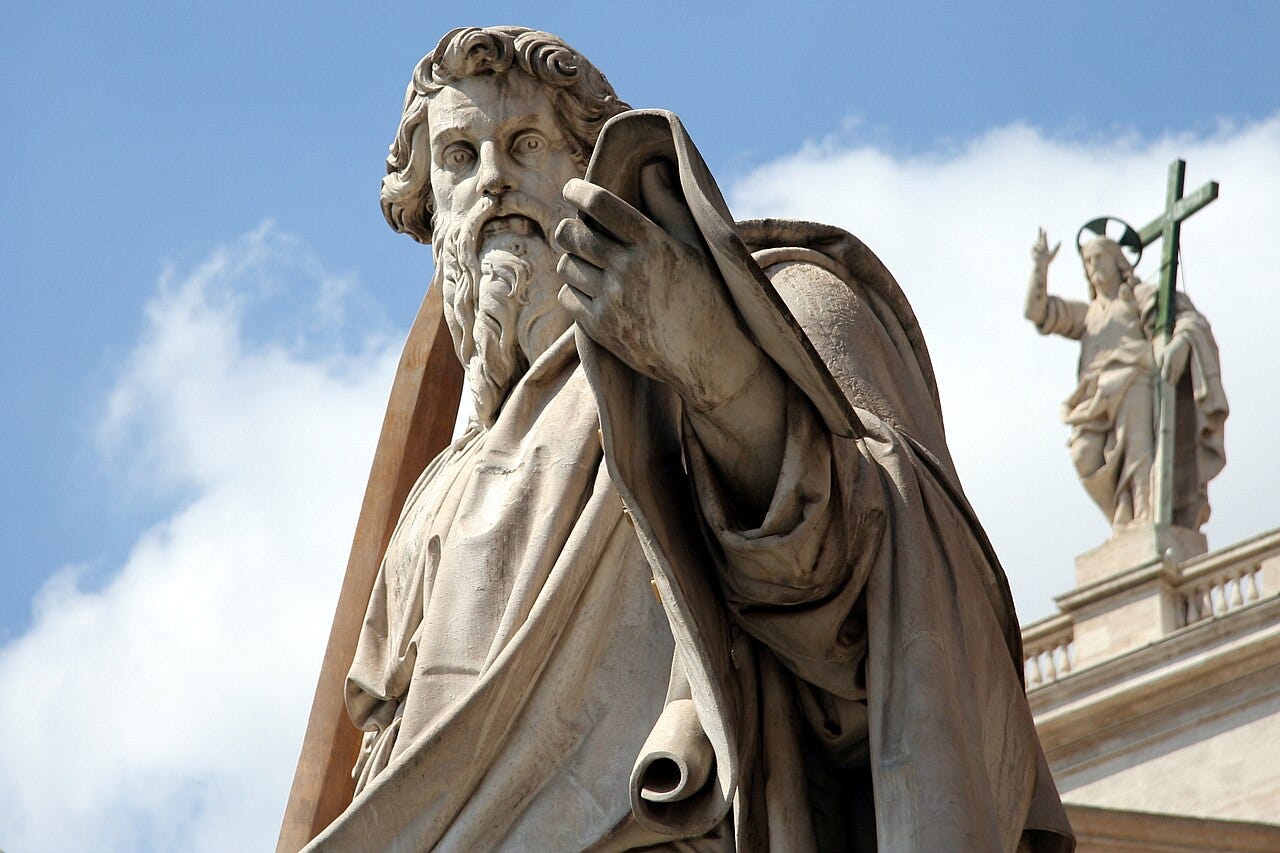
The image above of the statue of Paul on St Peter’s Basilica in Rome shows this visually. He is a messenger of Jesus.
Back to Romans:
First of all, Paul, as ‘the Apostle to the Gentiles’, is writing to a church he has not yet visited, and which he did not found. In the Acts of the Apostles, we are told there were visitors from Rome listening to the first sermon of the apostolic age, when Peter spoke to the crowds on the Day of Pentecost.
It seems as though such people, when they returned home, were the beginnings of the Christian community in Rome, which is then established into a local church by Peter at some point, and strengthened by Paul. Peter becomes Rome’s first bishop, and the line of his successors are there still today, governing the college of bishops as Pope.
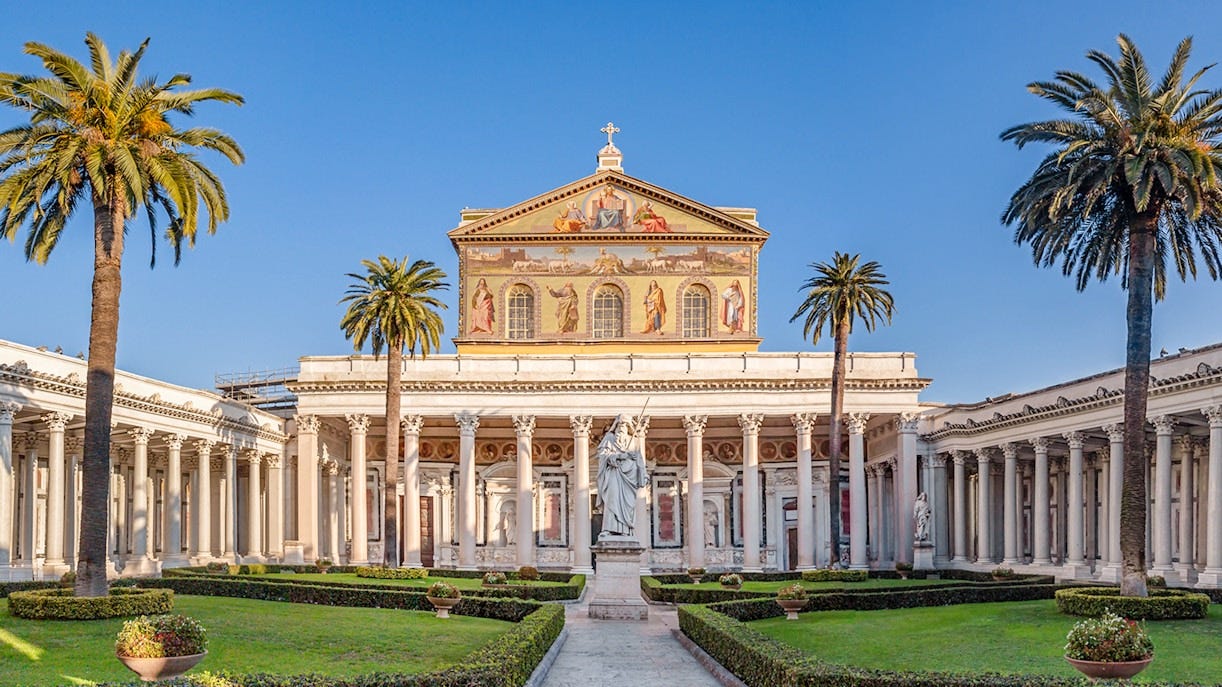
Both Peter and Paul are executed in Rome, ultimately, and Peter’s bones lie under St Peter’s Basilica today, while Paul’s are buried at the Basilica of St Paul Outside the Walls about 8 kilometres away:
This gives some sense of why this Letter to the Romans, as the Church of Rome is begining, is so important. Paul hints at the importance of Rome himself in 1v8: ‘…your faith is proclaimed throughout the world.’
The early Christians in Rome would have been made up of both Jews and Gentiles, and the theme of the letter is that both Jews and Gentiles are equal partners in the new People of God brought about by the life, death, and resurrection of Jesus.
Paul declares in Romans 1v16:
‘For I am not ashamed of the gospel, since it is the power of God that offers salvation to everyone who has faith—to Jews first, and then to Gentiles as well.’
Paul says he has been set apart to be an apostle of God for this gospel - the announcement that God is beginning to reign on earth through a new king, Jesus, ‘who according to the flesh was descended from David, and who according to the Spirit of holiness was proclaimed to be the Son of God in power by his resurrection from the dead…’
All nations have been called to a great redemption from sin and death by being baptised into the new life of Christ, who is of the Davidic line, but is also divine and eternal.
This has serious ramifications: faith in Christ is what ‘justifies’ the members of this great ekklesia (Greek for those who have been ‘called out’) and not adherence to the Jewish Law, or torah. It marks out their identity by infusing them with the life of God through faith and baptism, with baptism not being a mere ritual, like circumcision, but a sacrament, the visible means of an invisible grace:
‘Do you not know that all of us who have been baptized into Christ Jesus were baptized into his death? We were buried therefore with him by baptism into death, so that as Christ was raised from the dead by the glory of the Father, we too might walk in newness of life?’ [6v3-4]
Paul begins the main body of the letter by pointing out that both Jew and Gentile have wandered from God and are lost in sin and death. The Gentile has ignored the law written in their hearts and the natural knowledge of God while the Jew has ignored the revelation of God given through Abraham, Isaac, Jacob, and the law of Moses. Both share in the sinfulness of Adam. The world is filled with idolatry, immorality, and violence. And those find their root in the human heart.
Human culture (the outgrowth of its cult, or worship) that ‘suppress[es] the truth’ [1v18] naturally declines in all places into corruption and decadence. The very thought of the culture becomes ‘futile’ and ‘minds are darkened.’ This reaches a final nadir in which evil deeds are not only tolerated, but applauded. This is the moment of civilizational collapse.
Yes, the Jewish people were given the promises of God and from them came the maternal bloodline of Jesus. But they too fell short of the glory of God, to the extent that Paul says there is no advantage for we Jews, because all are under the power of sin. [3v9]
The Jews failed just as the Gentiles did. And, in particular, they failed in the God-given call to be a light to the nations.
Paul quotes Isaiah in 2v23: ‘You that boast in the law, do you dishonor God by breaking the law? For, as it is written, “The name of God is blasphemed among the Gentiles because of you.”’
(Note here that Paul is implying the existence of a human will, both individual and communal, and a relationship between that will and divine will. This is important when we come to the Calvinist intepretation of Romans 9.)
But in the midst of all this failure, the promises given to them, and through them all people, have now been fulfilled by the Messiah, who has done what nobody could do: overcome the sin of Adam. The Messiah is the True Israel. And now, to be a Jew is precisely to be a Christian.
In Romans 2, Paul says, ‘He is a Jew who is one inwardly’ [that is, baptised into Christ], and in chapter 9 he will write that ‘not all who are descended from Israel belong to Israel.’
It does not matter then whether you are circumcised or not, when considering either guilt or redemption. No distinction is made, because all are guilty and the righteousness now offered is apart from the law.
Chapter 3:
‘But now the righteousness of God that is attested by the Law and the Prophets has been manifested apart from law: the righteousness of God through faith in Jesus Christ for all who believe. No distinction has been made. For all have sinned and thereby are deprived of the glory of God, and all are justified by the gift of his grace that is given freely through the redemption in Christ Jesus.’
Paul recounts that the great intervention into human fallenness began with the story of Abraham. Abraham was not Jewish because the ethnos did not yet exist when he was called out of Mesopotamia (the land between two rivers). At this point he was still called ‘Abram’ and he also was not yet circumcised, as he began his pilgrimage to the Promised Land. Equally, he never lived under the torah because Moses only came centuries later.
Yet God reckoned his faith as righteousness anyway, and declared him to be the father of all those who have faith. He comes to receive his new name, ‘Abraham’, meaning ‘father of nations.’
Think of the significance of this. The father of faith is the father of nations. Nations, those sharing the same natus, or birth, are called to share in a great father’s great faith - faith in the one Creator God and his Anointed One.
Embedded in the great plan of cosmic redemption is not only the believer, but also the nation, participating in a universal faith, taking its place in a universal church.
(How different then is the modern conception of the state, as conceived both by a post-enlightened elite and many modernist Christians?)
Abraham’s name itself means that the promise of redemption was from inception that many nations would share his faith, faith in a coming, and now come, Christ (Christo - the anointed one). This then is Abraham’s true family: all the nations that share in his faith.
Therefore Paul writes that it is faith that justifies, that must justify, because all nations are called to God. It cannot be that mere adherence to one nation’s charter, the law given through Moses to Israel, is what justifies.
Paul emphasises this idea further by pointing out that the Mosaic law itself never rescued the Israelites from the Adamic nature they share with every other nation. If anything, ‘the law increased the trespass’ [5v20] because, despite the Law being good and spiritual, it does not issue new life. If anything, human nature, in its depths, tends to recoil against mere moral edict.
Jews and Gentiles alike are no longer to struggle in slavery under the weight of a torah that could not be fulfilled. Instead, the Spirit of God, through Jesus, makes us all children of God called to live in the love, peace and righteousness of God, and to participate in the ongoing redemption of the entire creation.
For the Jew who had not fulfilled the old covenant, and for the Gentile who had abandoned their Creator and their conscience, no matter what nation they were born into, life is no longer to be lived in a shadowy darkness of fear, blindly submitting to pagan or faithless powers. Instead, a People of God have been born to live under the rule of a new king.
Paul makes it clear in his Letter to the Galatians, that to persist with the torah becomes itself a kind of paganism; it is a turning from the God who makes himself known directly via his Son and his Spirit, to ‘weak and beggarly elemental spirits.’
Instead of this slavery, the People of God are to live as sons and heirs.
‘If God is for us, who can be against us?’
Not even death will separate this people from the love of God.
(A brief note: the letter, contra standard Protestant readings, is not primarily about the perils of self-righteousness. It bears on this, yes, but in the context of the wider theme of God’s rescue of all nations. This rescue takes place through the fulfillment of promises given to Israel by means of the Son of God, born from that nation who has risen from the dead and has begun his reign as king of all peoples. Without due attention to this framework, questions of individual justification will not be answered clearly. )
It is at this point that Romans 9 begins. It starts with an implied question: if all these things are true, why has so much of the old Israel rejected the Messiah, rejected the fulfillment of all the promises? Have they then been abandoned? And what does that mean for the unfolding of the remainder of the Abrahamic story?
To emphasize this again, the answers to these questions, addressed in this passage of scripture, have had enormous implications for not only personal faith, but for the governance of communities, nations, and the planet.
Let’s begin…
