
The Wisdom of Jesus, Son of Sirach
A text for 'aristocratic Christianity'
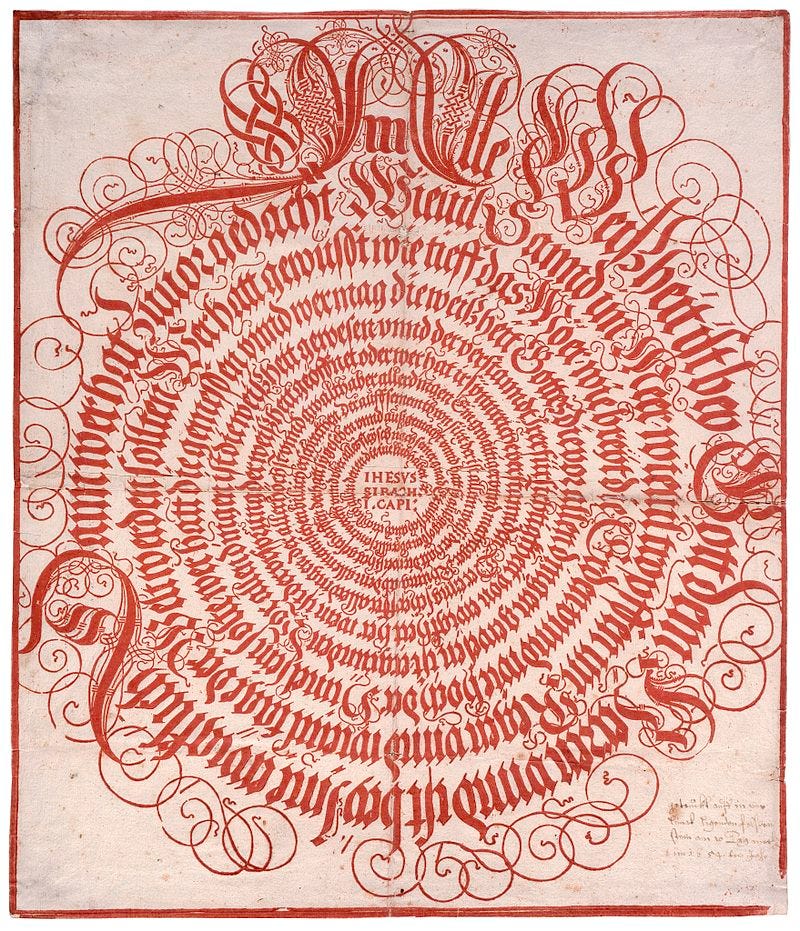
Jesus bar Sirach (or Joshua son of Sira) was a Hellenistic Jewish scribe and sage who wrote the biblical text Ecclesiasticus in Alexandria, Egypt circa 180 BC. (Not to be confused with a far superior namesake.)
Ecclesiasticus (‘church book’) appears in the early Greek Old Testament (the ‘Septuagint’) as well as Catholic and Orthodox Bibles, but is not regarded as canonical scripture by Jews or Protestants. It is also known as the Book of Sirach.
It begins with the words, ‘All wisdom comes from the Lord and is with him forever.’
It is the longest of the biblical wisdom (or ‘sapiential’) texts and its theme is similar to that of Proverbs: the universe is held together by divine wisdom. This wisdom can be seen in nature and also in the lives of holy men and women:
The Lord himself created wisdom;
he saw her and apportioned her,
he poured her out upon all his works.
She dwells with all flesh according to his gift,
and he supplied her to those who love him.
The third chapter tells us that honouring one’s father atones for sins, that glorifying one’s mother lays up treasure for oneself, and that giving to the poor covers sins as ‘water extinguishes a blazing fire.’
The fourth chapter continues relating the duties of the godly man in relation to others in his society.
We are told to bow to great men but equally to incline our ears to the poor; to deliver those who have been wronged by their enemies; to be a father to the orphan and a husband to the widow, so that we will be like ‘a son of the Most High.’
This is no servile life of faith. There is to be both recognition and stewardship of greatness. We are to bow—and to incline, to condescend. There is meant to be a kind of order to a society (great ones, fathers, mothers, guided by true Wisdom), and that is ranked order is to be tempered by mercy.
This struck me as existing in contradistinction with much of modern ‘western’ life, which often maintains the appearances of a Christian tradition within a kind of revolutionary spirit.
In our secular, ‘welfare’ societies, there is to be no greatness or hierarchy, and care for the poor should come from massive state bureaucracies or bloated NGOs. All too often, churches empty themselves of any kind of spiritual identity or authority to become mere adjuncts to this thoroughly earthly and disenchanted kingdom: a vision of the Christian faith as mere social democracy.
(In this regard, I often think of lines from a Johnny Cash song: ‘I stopped outside a church house, where the citizens like to sit/ They say they want the kingdom, but they don’t want God in it.’)
And the wisdom of the ages, the wisdom of those anointed by God, is thus neglected as anti-scientific superstition, to be superseded by technocratic expertise (or perhaps non-Christian pseudo-spirituality):
‘It is too dangerous to pray for the dying; you cannot gather to share the Eucharist; you must be vaccinated with serums containing human fetal DNA, chicken embryo protein, proteins from worm ovaries, and monkey kidney DNA fragments.’
This is for the sacred causes of health and safety.
The chapter continues on to the theme of God-given wisdom:
Whoever holds Wisdom fast will obtain glory,
and the Lord will bless the place he enters.
Those who serve her will minister to the Holy One;
the Lord loves those who love her.
He who obeys her will judge the nations,
and whoever gives heed to her will dwell secure.
If he has faith in her he will obtain her;
and his descendants will remain in possession of her.
We are encouraged to listen to divine Wisdom, to hold it within ourselves, so that we may obtain glory, that our homes are blessed, and that we may judge nations and pass this possession of wisdom onwards to our descendants.
We are here far beyond the realm of the exercise of faith as mere adherence to moral platitudes concerning social egalitarianism and tolerance. This kind of Wisdom has fire. It is aristocratic insofar as it concerns human affairs, and monarchical in its cosmic outlook.
Achieving ‘aristos’ and glory by embracing wisdom is not easy, however. One must walk with wisdom, according to the ancient writer, ‘on torturous paths’ upon which you will be ‘stricken with fear’ and ‘tormented by her discipline.’
We have here hints of the Cross… But after persevering, ‘Wisdom will come straight back to him and gladden him, and will reveal her secrets to him.’ Tranfiguration follows suffering.
How then should this hardened, gladdened life of Wisdom carry itself in this world of shadows?
Do not show partiality, to your own harm,
or deference, to your downfall.
Do not refrain from speaking at the crucial time,
and do not hide your wisdom.
There is a deference that leads to downfall; there is a crucial time to speak.
Do not be ashamed to confess your sins,
and do not try to stop the current of a river.
Do not subject yourself to a foolish fellow,
nor show partiality to a ruler.
Strive even to death for the truth
and the Lord God will fight for you.
How many of us strive even to death for the truth?
Is it any wonder this ancient scripture is so neglected in our own time, or how few of us are true lovers of Wisdom, and thus true philosophers?
Consider becoming a paid subscriber to support this work.
You will receive access to all posts as well as a free copy of my book, Rage and Love: A Memoir of White South Africa in an Age of Destruction.
There must be a reason - a fear, perhaps - that several councils of religious leaders established our Biblical canon, which does not include powerful books now relegated to apocryphal status. Sirach is one such; 1 Enoch and Jubilees are others. The apostle Paul and the prophet Daniel both make references to ideas and events that appear in Enoch. Our Lord Jesus clearly believed in demons - else what entities was He casting out of possessed people in His day?