
Discovering the Genuine Hegel
In parallel with my Nietzschean project
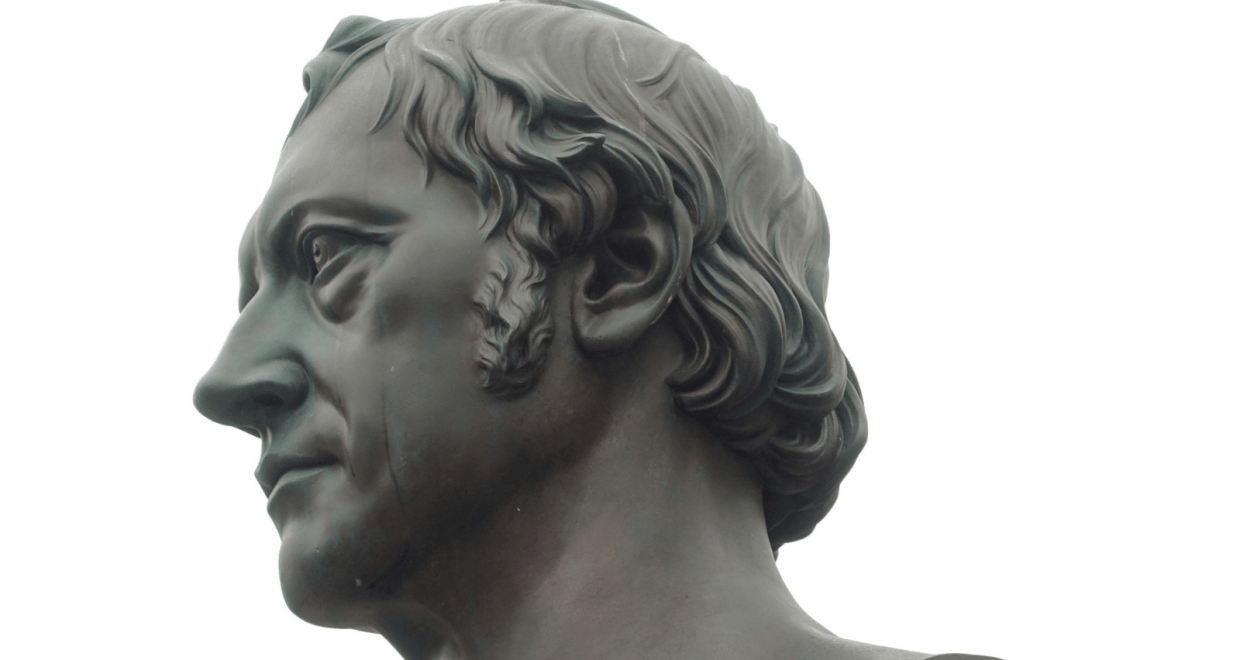
‘Those who think they know something do not yet know as they ought to know. But whoever loves God is known by God.’
Paul’s First Letter to the Corinthians
If a philosopher becomes too dangerous to the modern regime, but impossible to censor, what solution remains open to regime apparatchiks in the world of academia?
The answer is: deliberate misinterpretation.
We have seen this in Nietzsche. Nietzsche the radical was replaced with Nietzsche the existentialist and/or Nietzsche the postmodernist. His ‘will to power’ doctrine subsumed within perspectivism. He became to so many the embodiment of the nihilism against which he struggled.
(The Word and the Flame sought to correct this.)
What if this is true also of the great German philosopher, Georg Wilhem Friedrich Hegel (1770-1831)?
There are multiple versions of Hegel.
We have the proto-Marxist Hegel. Marx’s engine of history was the material dialectic of class conflict. Hegel was the philosopher of the dialect, of an unfolding history. Therefore, Hegel is Marxist.
Then we have the statist Hegel, who many have supposed to have written that the state is a god on earth, thus legitimizing the Prussian state and the First Reich of Bismarck, and anticipating the modern secular state.
Modern liberals tend to believe there is a ‘light’ side to this statist darkness. Namely the modern liberal state in which all people find their identity in the rights guaranteed to the citizenry, who come to recognise and identify themselves with the liberal values espoused by state machinery.
Recently we have had the ‘woke’ Hegel. This has been popularised by various ‘anti-woke’ neoconservative types, namely James Lindsey. Lindsey believes that Hegel’s dialectic in which Spirit becomes conscious of itself in history is the grounds for a modern religion in which secular revolutionaries up-end private property and things like free speech and classical liberalism.
Part of the reason for the existence of multiple Hegels is surely his obtuse style of writing. He wrote in a German academic dialect that is very difficult to translate. He used words in specialist, idiosyncratic ways.
Not only did this leave him vulnerable to misinterpretation, but also to misinterpretation by those who refused to read him or simply could not, at the hands of those who wished to neuter the power of his thought.
I have come to realise that most of these interpretations, although containing grains of truth, can be discarded merely by a cursory understanding of Hegel.
(I have to thank here THREE SE7EN MAFIA (THOMAS777), Peter R. Quiñones, and Dr Matthew Raphael Johnson for their recent conversations on Hegelianism.)
First, Marx did use the terminology of Hegel, while discarding his crucial beliefs in: God, Spirit, metaphysical Logic, Absolute Knowledge, class sympathy, nationalism, etc, etc. Marx embraced Darwin who had embraced Thomas Malthus. Two of the most anti-Hegelian thinkers imaginable. Marx is not Hegelian.
Second, Hegel never declared the state to be a god. Quite the opposite. The state rests on a shared culture and must be mediated by family, guilds, and civil society.
This confusion is of piece with the fact that Hegel also never described the dialectic as ‘thesis, antithesis, synthesis’ as though Hegel foresaw the bureaucratic’s state strategy of creating problems in order to pose a solution leading to a new governing dispensation.
What Hegel meant by the dialectic is not an embrace of the bureaucratic state’s edicts, in order to be on ‘the right side of history.’
The dialectic is rather something akin to the words of Paul above. Our knowledge requires fulfillment. We do not know yet as we ought to know. Higher knowledge comes through love, and through being known. We have the potential to live in truth.
The modern epistemological crisis, in which we radically doubt anything can be known securely, is resolved politically, in a shared conversation, in a shared language.
(But what if the polis is entirely corrupted? Then so would epistemology. Can we observe this conenction in our world today?)
As the renowned British Hegelian thinker, Michael Oakeshott wrote, ‘Education is an initiation into the conversation of mankind.’
(But what if God is speaking to us, and through us, too?)
Third, Hegel’s version of the state has almost nothing in common with the modern liberal state. For him, the state emanated from shared language, history, and blood, and was the grounds for logic and an instantiation of universal reason. Human rights was an untenable concept for him because there was no such thing as an abstract human individual.
Hegel was in essence and opponent of the entire Enlightenment project and especially its bloody work in Revolutionary France. Because the modern world is at its heart an affirmation of the Revolution, Hegel had to be gutted of his key insights and doctrines.
Finally, contra Lindsey, Hegel was a committed Christian. He believed the Incarnation of God was the foundation of all philosophy and Christianity the Absolute Religion. (This is not to say Hegel’s understanding of Christianity was flawless.) To surmise that Hegel has anything to do with LGBT and critical race theory becomes laughable.
So then, who was Hegel, and what is the essence of his thinking?
Below is my attempt to answer the question, based on the dialogues of the aforementioned and my own reading. Because of the vastness and the complexity of Hegel’s corpus, I will necessarily be engaging in vast amounts of over-simplification. But that is probably the only way to begin…
A taster before the paywall:
Hegel is the philosopher par excellence of modern alienation. In the face of Descartes’ self-doubt and Kant’s assertion that the real world, the thing-in-itself, is fundamentally unknowable, Hegel demonstrates that we can know truth, because we participate in truth, because we participate in the Spirit of community, which embodies the creative logos of God himself.
This is the basis of our individuality. There is a way through the alienation that makes perfect, philosophical sense, and it is a way that solves problems of modern epistemology and politics together.
Paywall.
Not only do paid subscribers get access to all essays such as this, the Liberal Myths series and my full archive, they also receive free copies of both my books: Rage and Love and The Word and the Flame. For the price of a fortnightly flat white or a monthly magazine, sign up below.
